

Professional Standards & Ethics
Careful Research. Documented Evidence. Professional Responsibility.
Every family history project deserves careful, responsible research. My work is guided by established genealogical standards and professional ethics, with an emphasis on thorough research, accurate source citations, careful analysis of evidence, and clearly explained conclusions.
I also respect the privacy of clients and living individuals and handle sensitive family information with discretion.

My Professional Commitments
My research practices are guided by the ethical principles and professional standards established within the genealogical community, including those published by the Association of Professional Genealogists (APG) and the Board for Certification of Genealogists (BCG).
Accuracy and Evidence
I will report findings accurately and distinguish documented facts from assumptions, interpretations, and conclusions. Sources will be identified and cited so that the evidence supporting the research can be evaluated. APG requires clear, organized work based on reliable, fully cited sources; BCG similarly emphasizes documentation, evidence evaluation, and conclusions supported by evidence.
Honest Representation
I will accurately represent my experience, credentials, services, fees, and the realistic possibilities and limitations of genealogical research. I will never guarantee that a particular ancestor, record, relationship, or answer can be found.
Clear Agreements and Client Control
Before paid research begins, the research objective, authorized time, fees, expenses, and expected deliverables will be clearly established. Clients remain informed about significant delays or changes, and additional research or expenses will not be undertaken without authorization.
Confidentiality and Privacy
Client communications, research, and information concerning living individuals will be treated confidentially and responsibly. Information will not be publicly shared without appropriate consent, and particular care will be taken with sensitive personal and genetic information.
Respect for DNA Participants
DNA evidence will be handled with particular attention to privacy, informed consent, and the potential effect that genetic discoveries may have on living individuals and their families. BCG's standards specifically address DNA evidence and privacy rights.
Responsible Use of Records
Historical records, archival materials, repositories, and their staffs will be treated with respect. Records will not be altered, damaged, improperly removed, or misrepresented.
Respect for the Work of Others
The research, writing, images, and intellectual contributions of other genealogists and researchers will be properly credited. I will not present another person's work as my own.
Conflicts of Interest
Any personal, professional, or financial conflict that could affect my obligations to a client will be disclosed.
Continuing Education
Professional genealogy requires continued learning. I will continue developing my knowledge of genealogical methodology, records, technology, DNA research, and professional practices. APG's current code expressly includes continuing education as an ethical commitment.
Honest Reporting of Unsuccessful Research
Not every genealogical question can be answered. If the available evidence does not support a conclusion, I will say so. Negative searches, conflicting evidence, and unresolved questions will not be concealed simply to produce a more satisfying answer. This is consistent with BCG's emphasis on evaluating evidence, resolving conflicts when possible, and avoiding unsupported conclusions.
The Genealogical Proof Standard
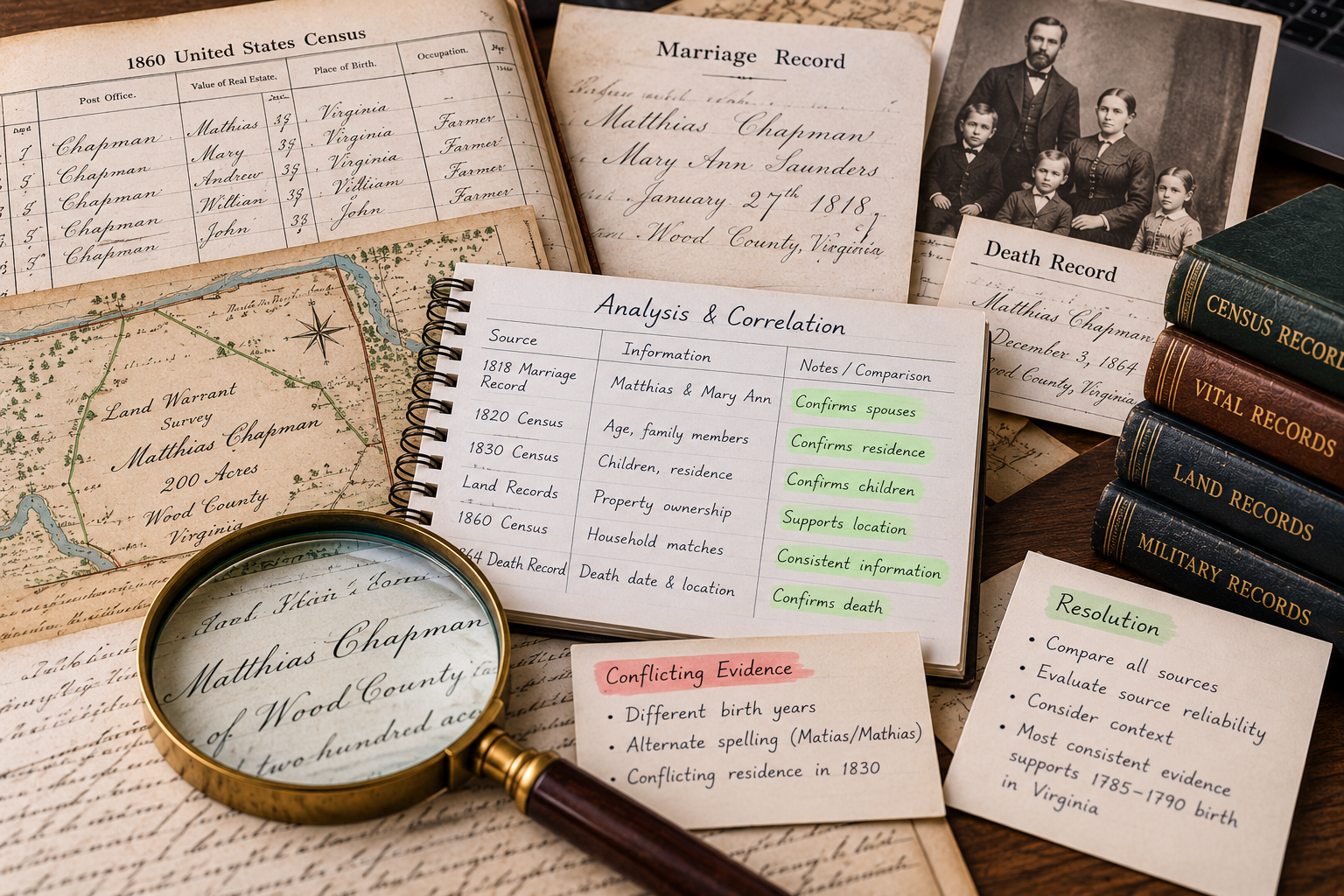
Reliable genealogy requires more than finding a record that appears to contain the right name. Genealogists must gather sufficient evidence, evaluate that evidence in context, address contradictions, and reach conclusions that the evidence can support.
The Genealogical Proof Standard (GPS) provides a framework for establishing credible genealogical conclusions.
Then present the five elements as five numbered items:
1 — Reasonably Exhaustive Research
Search a sufficiently broad range of relevant sources so that important evidence is unlikely to have been overlooked.
2 — Complete and Accurate Source Citations
Document the sources used so that the evidence can be identified, evaluated, and located again.
3 — Analysis and Correlation of Evidence
Compare information from multiple sources and consider how the evidence supports, contradicts, or relates to other findings.
4 — Resolution of Conflicting Evidence
Identify contradictions in the evidence and attempt to resolve them before reaching a conclusion.
5 — A Soundly Reasoned Written Conclusion
Present a clear conclusion that explains how the evidence supports the genealogical finding.
The goal isn't simply to find an answer. It's to determine whether the available evidence supports that answer.
Privacy, Confidentiality & Sensitive Research
Genealogical research can uncover information that is personal, unexpected, or sensitive. Client information and research materials are handled with discretion, and the privacy of living individuals is taken seriously.
Research involving DNA, adoption, unknown parentage, or other sensitive family circumstances requires particular care.
Client Confidentiality
Information you provide for a research project is treated as confidential and is used for the purpose of conducting your research.
Living Individuals
Personal information concerning living people is handled carefully and is not unnecessarily disclosed in reports or other research materials.
DNA & Genetic Genealogy
DNA results and information about genetic matches are treated as sensitive information. Conclusions are based on the available genetic and documentary evidence and its limitations are explained.
Contacting Other People
I will not contact DNA matches, biological relatives, family members, or other living individuals on your behalf without your specific authorization.
Unexpected Discoveries
Genealogical and DNA research can reveal unexpected relationships, previously unknown relatives, misattributed parentage, adoption, or other sensitive information. Findings are reported factually and respectfully without concealing evidence relevant to the research objective.

Honest Research. Honest Conclusions.
Genealogical research does not always produce the answer we hope to find. Records may have been lost or destroyed, individuals may not appear in surviving records, and sometimes the available evidence is simply insufficient to establish a relationship or conclusion.
I will never manufacture a connection, ignore contradictory evidence, or present a possibility as a proven fact simply to provide a more satisfying result.
When a question cannot be resolved, I'll explain what was searched, what the evidence shows, what remains uncertain, and—when appropriate—what additional research may still be worthwhile.
A professional genealogist's responsibility is to the evidence, even when the evidence does not provide the answer we hoped to find.
Research You Can Understand and Trust
Whether you're trying to identify an ancestor, solve a long-standing family mystery, understand DNA evidence, or document your family's history, the research should be based on evidence you can evaluate and understand.
Your first consultation is free.
Tell me what you're trying to discover, and I'll help determine the best way to approach the research.